
Pull-ups (pronated grip)
The overhand pull-up mainly trains your lats, with help from your upper back, biceps and forearms. You move your own bodyweight, so it is also a good test of relative strength: the stronger and leaner you are, the more reps you get.
Updated November 7, 2026
On this page
Why do it
It usually opens back or pull day, while you are fresh. If you cannot do one yet, start with assisted or negative reps plus lat pulldowns, and reduce the assistance over time.
Setup
- Grab the bar a little wider than your shoulders, thumbs wrapped around it.
- Before you pull, hang with straight arms and draw your shoulders slightly down, away from your ears, without bending your elbows.
- Keep your legs together and lightly brace your glutes and abs so your body does not swing.
How to do it
- 1
Stand in front of a pull-up bar with your feet shoulder-width apart.
- 2
Reach up and grab the bar with an overhand grip, slightly wider than shoulder-width apart.
- 3
Hang from the bar with your arms fully extended and your body straight.
- 4
Engage your back muscles and pull your body up towards the bar, leading with your chest.
- 5
Pause for a moment at the top, then slowly lower your body back down to the starting position.
- 6
Repeat for the desired number of repetitions.
Technique cues
- Think about driving your elbows down toward your back pockets, not about lifting your chin.
- Pull until your chin clears the bar, chest heading toward it.
- Lower over two or three seconds until your arms are fully straight.
- Stay still: no kicking or swinging for momentum.
Muscles worked
The lats do most of the work, especially in the first half of the pull. The upper back (middle traps, rhomboids) and rear delts help near the top, and the biceps work throughout. If the top is easy but you cannot get moving from the bottom, build that position with hangs and scapular pulls: shoulders down, arms straight.
- Primary
- Lats
- Secondary
- Upper back
- Equipment
- Pull-up bar
Common mistakes
1. Half reps
Not straightening your arms at the bottom or not clearing the bar at the top makes it look like you do more than you do. Count only full reps.
2. Swinging or kicking
Momentum lifts your body without your back doing the work. Pause at the bottom of each rep and start from a dead hang.
3. Craning your neck at the bar
Pushing your chin forward fakes the finish without pulling higher. Look ahead and bring your chest toward the bar.
4. Dropping on the way down
Falling into the bottom wastes the part that helps you progress most. Control the descent, especially if you only get a few reps.
Variations and alternatives
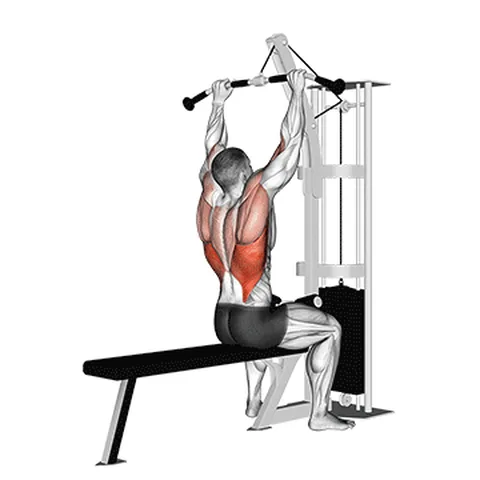
Lat pulldown
The same vertical pull at whatever weight you choose. The best option if you cannot do pull-ups yet, or for extra volume afterward.
Assisted pull-up (band or machine)
A band or an assisted machine takes off part of your bodyweight. Reduce the help as you get stronger.
Negative pull-up
Jump or step up to the top and lower over 3-5 seconds. Builds strength when you cannot do a full rep yet.
Chin-up
With your palms facing you, your biceps help more and it usually feels a bit easier.
Sets and reps
| Goal | Sets | Reps | Rest |
|---|---|---|---|
| Strength (weighted) | 3-5 | 3-6 | 3 min |
| Muscle (hypertrophy) | 3-4 | 6-12 | 2 min |
| Beginners | 3-4 | 3-5 negatives or assisted | 2 min |
If you cannot do one yet, pair negatives or assisted reps with lat pulldowns twice a week. Once you can do 8-10 in a row, add weight with a dip belt, starting at 5-10 lb.
FAQ
I can't do a single pull-up. Where do I start?
With negatives, band- or machine-assisted pull-ups, and lat pulldowns. Training twice a week, most people get their first full rep within a few weeks to a few months.
What's the difference between pull-ups and chin-ups?
Palms facing away (pull-up) works the lats more and is harder; palms facing you (chin-up) gets more help from the biceps. Both are good.
Do I need to touch the bar with my chest?
No. The usual standard is chin over the bar, with fully straight arms at the bottom.
Alternatives
Related exercises
At a glance
- Primary
- Lats
- Secondary
- Upper back
- Equipment
- Pull-up bar
- Steps
- 6

