
Lat pulldown (pronated grip)
The pronated-grip lat pulldown is the most common machine exercise for the lats, the muscles that make your back wider. It is the same motion as a pull-up, but you choose the weight, so it works whether you cannot do pull-ups yet or want extra volume on top of them.
Updated November 7, 2026
On this page
Why do it
Because it is guided and easy to adjust, it is a good exercise to take close to failure safely. Put it after a heavier back exercise such as rows or pull-ups, or first if you are still learning.
Setup
- Set the thigh pad so it holds your legs down and you cannot lift off the seat when you pull.
- Grip the bar a little wider than your shoulders, palms facing forward, and sit down with your arms straight.
- Lean back slightly (about 10-20°) and lift your chest; keep that angle for the whole set.
How to do it
- 1
Adjust the cable pulldown machine so that the seat is at a comfortable height and the knee pad is secured.
- 2
Sit on the seat with your back straight and your feet flat on the ground.
- 3
Grasp the cable bar with an overhand grip, slightly wider than shoulder-width apart.
- 4
Lean back slightly and engage your core.
- 5
Pull the cable bar down towards your chest, squeezing your shoulder blades together.
- 6
Pause for a moment at the bottom of the movement, then slowly release the bar back to the starting position.
- 7
Repeat for the desired number of repetitions.
Technique cues
- Start each rep by pulling your shoulders down, away from your ears, before you bend your elbows.
- Think about driving your elbows toward your back pockets, not pulling the bar to your chest.
- Bring the bar to your upper chest and pause briefly at the bottom.
- Let it rise slowly until your arms are straight and you feel the stretch in your lats.
Muscles worked
Your lats do most of the work as your arms come down toward your sides. The teres major, rhomboids and middle traps help pull your shoulder blades down and back, and your biceps and forearm flexors help bend your elbows. If you mostly feel your arms, you are probably starting the pull with your elbows instead of your shoulders.
- Primary
- Lats
- Equipment
- Gym machine
Common mistakes
1. Leaning too far back
If you lie back to get the bar down, the pulldown turns into a row and you use momentum. Keep a fixed lean and lower the weight.
2. Pulling with your arms only
If your biceps tire before your back, you are starting each rep by bending your elbows. Pull your shoulders down first, then drive your elbows down.
3. Cutting the top short
Not straightening your arms removes the part of the rep where your lats are most stretched. Let the bar rise until your arms are straight, without losing tension.
4. Pulling the bar behind your neck
It adds no extra back work and puts your shoulders in an awkward position. Always pull in front, to your upper chest.
Variations and alternatives
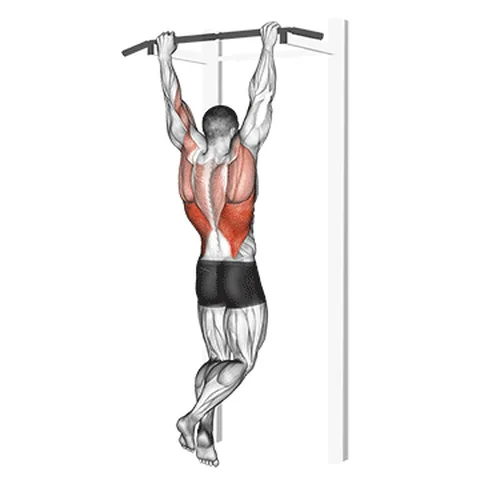
Pronated-grip pull-up
The same motion with your bodyweight. Once you can do several sets of pulldowns with close to your bodyweight, try switching to pull-ups.
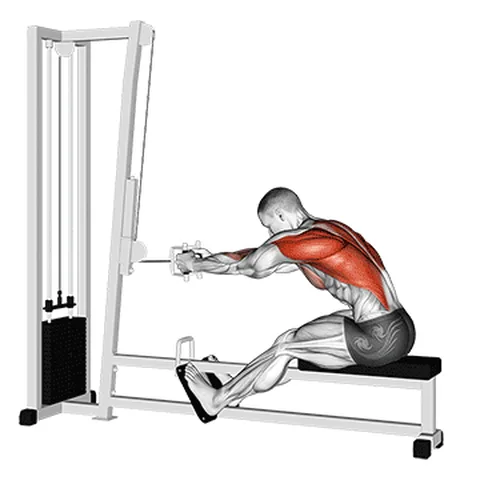
Seated cable row
A horizontal pull instead of a vertical one: it works your mid-back more and pairs well with pulldowns.
Neutral or close-grip pulldown
With your palms facing each other, the grip is more comfortable for many people and lets you lift a little more. Lat work is very similar.
Sets and reps
| Goal | Sets | Reps | Rest |
|---|---|---|---|
| Muscle (hypertrophy) | 3-4 | 8-12 | 1.5-2 min |
| Endurance and technique | 2-3 | 12-15 | 1-1.5 min |
| Beginners | 3 | 10-12 | 1.5 min |
Add weight once you hit every rep in the range with the technique above. Two back sessions a week with 10-20 total sets, counting pulldowns and rows, is a common volume for building muscle.
FAQ
Lat pulldown or pull-ups?
They train the same muscles. Pulldowns let you choose the weight and reach failure with more control; pull-ups make you move your own body. If you cannot do pull-ups yet, pulldowns are how you build up to them.
Wide or close grip?
A grip a little wider than your shoulders is a good starting point. Going wider does not necessarily work your lats more and shortens the range of motion; use the grip that lets you pull without discomfort.
Should I lean back?
A little: about 10-20° lets the bar clear your face. What matters is that the lean stays the same during the rep.
Alternatives
Related exercises
At a glance
- Primary
- Lats
- Equipment
- Gym machine
- Steps
- 7

