
Bilateral hammer curl (dumbbell)
The hammer curl uses a palms-facing-in grip, and that neutral grip spreads the work between the biceps, the brachialis and the brachioradialis, the big muscle on top of your forearm. That is why it adds more thickness to the arm from the side, and to the forearm, than a regular curl.
Updated November 7, 2026
On this page
Why do it
Put it at the end of pull or arm day, after a palms-up curl. You can usually handle a bit more weight than on a regular curl, so it also helps build grip strength.
Setup
- Stand with your feet hip-width apart and your knees soft, not locked.
- Dumbbells at your sides with your thumbs forward, shoulders down and slightly back.
- Elbows against your sides, just under your shoulders: that is the point that should not move during the set.
How to do it
- 1
Stand up straight with a dumbbell in each hand, palms facing your torso (neutral grip).
- 2
Keep your elbows close to your torso and maintain the neutral grip with your palms facing your torso throughout the movement.
- 3
This will be your starting position.
- 4
Now, keeping the upper arms stationary, exhale and curl the weights while contracting your biceps.
- 5
Continue to raise the weights until your biceps are fully contracted and the dumbbells are at shoulder level.
- 6
Hold the contracted position for a brief pause as you squeeze your biceps.
- 7
Then, inhale and slowly begin to lower the dumbbells back to the starting position.
- 8
Repeat for the recommended amount of repetitions.
Technique cues
- Only your forearm moves: your elbow stays pinned to your side.
- Curl until the dumbbell is near your shoulder without your elbow drifting forward.
- Keep your wrist straight, in line with your forearm.
- Lower over two or three seconds until your arm is fully straight.
Muscles worked
The brachialis and brachioradialis work harder than in a regular curl because of the neutral grip, and the biceps help throughout. You feel the brachioradialis most in the middle of the rep. If your grip tires before your arms, your forearms are the limit: keep going, they are getting trained too.
- Primary
- Biceps
- Secondary
- Forearms
- Equipment
- Dumbbells
Common mistakes
1. Swinging your torso
Momentum lifts the dumbbell instead of your arm. Go lighter, stand against a wall if needed, and curl without swinging.
2. Elbows drifting forward
When your elbow comes forward, your shoulder helps and your arm does less. Keep it pinned to your side the whole rep.
3. Stopping short at the bottom
Leaving your elbow bent cuts off the longest part of the range. Straighten your arm fully before the next rep.
Variations and alternatives
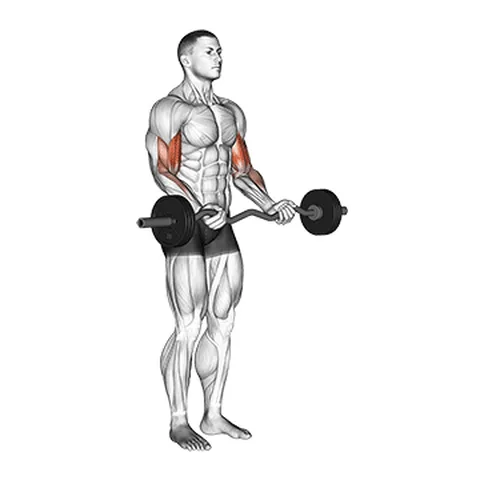
EZ bar curl
Your palms face more upward, so the biceps work more. Both arms together let you load more weight.
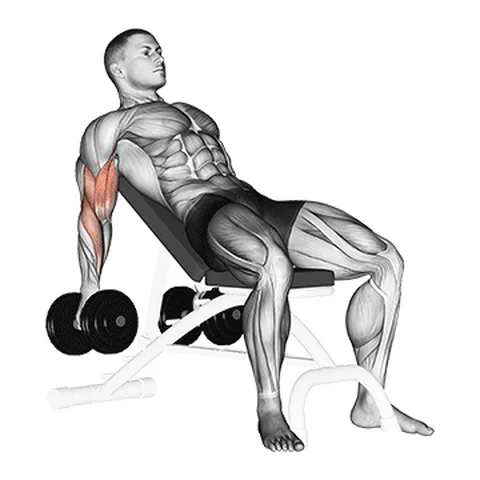
Incline dumbbell curl
On an incline bench, your arm starts behind your body and the biceps work from a longer stretch.
Alternating hammer curl
One arm at a time: easier to focus on each side, though the set takes longer.
Sets and reps
| Goal | Sets | Reps | Rest |
|---|---|---|---|
| Muscle (hypertrophy) | 3-4 | 8-15 | 60-90 s |
| Arm and grip strength | 3 | 6-10 | 90 s-2 min |
| Beginners | 2-3 | 10-12 | 60-90 s |
Move to the next dumbbell once you hit the top of the rep range on every set without swinging. The jump is usually 2.5-5 lb per hand; if you cannot make it, add reps before adding weight.
FAQ
What does the hammer curl work that a regular curl doesn't?
The neutral grip loads the brachialis and brachioradialis more. Your biceps still work, but your forearms get more involved.
Alternating or both arms at once?
Both at once makes the set shorter and, if you keep your torso still, you swing less; alternating lets you focus on each arm. Both work.
Should I rotate my wrist as I curl?
No. In a hammer curl your palms face each other the whole way; if you rotate, it becomes a regular curl.
Related exercises
At a glance
- Primary
- Biceps
- Secondary
- Forearms
- Equipment
- Dumbbells
- Steps
- 8

