
Pec deck (machine)
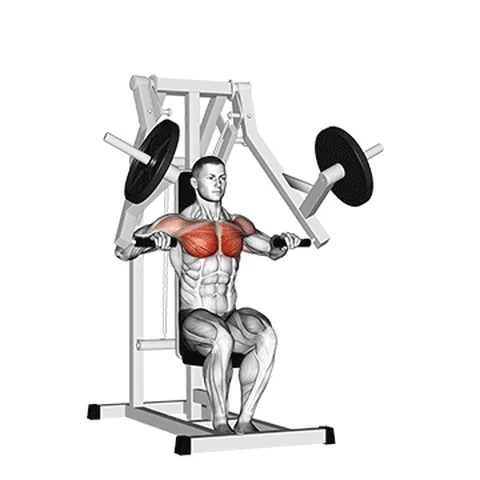
The pec deck is a machine chest fly: it trains your chest by bringing your arms together in front of your body, without your triceps having to straighten your elbows. Your chest works on its own, and the machine keeps tension through the whole range.
Updated November 7, 2026
On this page
Why do it
It goes after your chest presses, once the heavy work is done. Because it takes no technique or balance, it is easy to push sets close to failure without losing position.
Setup
- Set the seat so the handles are at mid-chest height, with your arms almost parallel to the floor.
- If the machine allows it, set the range so you feel a comfortable stretch in your chest at the open position, without your arms going behind your body.
- Back against the pad, chest up and shoulders down, away from your ears.
How to do it
- 1
Adjust the seat height and position yourself on the machine with your back against the pad.
- 2
Grasp the handles with a pronated grip and keep your elbows slightly bent.
- 3
Exhale and push the handles forward, bringing them together in front of your chest.
- 4
Pause for a moment, squeezing your chest muscles.
- 5
Inhale and slowly return to the starting position, allowing your chest muscles to stretch.
- 6
Repeat for the desired number of repetitions.
Technique cues
- Elbows slightly bent and locked in that angle: it does not change during the rep.
- Think of hugging a tree: bring your arms together in front of your chest by driving your elbows inward.
- Squeeze for a second when the handles meet, without coming off the pad.
- Open over two or three seconds until you feel the stretch, without letting the stack touch down.
Muscles worked
The pecs do almost all the work, especially as your arms come together in front of you. The front delts help in the open part of the range. If you feel your shoulders more than your chest, you are probably opening too far or the seat is too low: raise the seat and shorten the stretch a little.
- Primary
- Chest
- Equipment
- Gym machine
Common mistakes
1. Coming off the backrest
Rolling your shoulders forward to bring the handles together shifts the work to your delts. Drop the weight and keep your back on the pad.
2. Bending and straightening your elbows
If your elbow angle changes, the fly turns into a press and your triceps help. Set a slight bend and hold it.
3. Opening too far
Taking your arms well behind your body puts your shoulders in an awkward position. Open to a comfortable stretch and stop there.
4. Letting the weight pull you open
Letting the stack yank your arms back loses tension. Control the return as much as the squeeze.
Variations and alternatives
Machine chest press
A press instead of a fly: your triceps help and you can load more. It comes before the pec deck in a session.
Reverse pec deck
The same machine facing the pad, opening your arms backward. It trains the rear delts, not the chest.
Cable fly
Cables let you change the height and angle of the cross to aim the work at your upper or lower chest.
Sets and reps
| Goal | Sets | Reps | Rest |
|---|---|---|---|
| Muscle (hypertrophy) | 3-4 | 10-15 | 60-90 s |
| End-of-session volume | 2-3 | 12-20 | 60 s |
| Beginners | 2-3 | 12-15 | 60-90 s |
Move up one plate once you hit the top of the rep range on every set with your back on the pad and your elbows fixed. This is not a lift for heavy low-rep sets; progress mostly through reps.
FAQ
Pec deck or dumbbell flys?
The pec deck keeps tension through the whole range and is easier to control; with dumbbells the load concentrates in the open position. Both train the chest.
How high should the seat be?
So the handles are at mid-chest and your arms are almost parallel to the floor. If you feel it a lot in your shoulders, raise the seat.
Before or after bench press?
After. The bench moves more weight and needs you fresh; the pec deck finishes off your chest.
Alternatives
Related exercises
At a glance
- Primary
- Chest
- Equipment
- Gym machine
- Steps
- 6

