
Standard push-ups
The push-up is the basic equipment-free press: it trains your chest, front delts and triceps, and makes your abs and glutes hold your body straight. You can do it anywhere and adjust the difficulty by changing your body angle.
Updated November 7, 2026
On this page
Why do it
It works as a main exercise if you train at home or are just starting out, and as a finisher on gym chest day for extra volume after your weighted presses.
Setup
- Place your hands level with your lower chest, not your face, fingers pointing forward.
- Squeeze your glutes and abs so your hips, shoulders and heels line up before you start lowering.
- If you cannot do full push-ups yet, put your hands on a bench or table: the higher, the easier.
How to do it
- 1
Place your hands on the floor slightly wider than shoulder-width apart.
- 2
Extend your legs behind you, balancing on your toes.
- 3
Keep your body in a straight line from head to heels.
- 4
Lower your chest toward the floor by bending your elbows.
- 5
Push back up to the starting position.
- 6
Repeat for the desired number of repetitions.
Technique cues
- Elbows about 30-45° from your body on the way down, making an arrow with your torso, not a T.
- Lower until your chest is a finger or two off the floor.
- Push the floor away and finish with your shoulder blades slightly spread.
- Your body moves as one piece: hips do not sag or lag behind.
Muscles worked
Your chest does most of the work in the bottom half, the front delts help throughout, and the triceps finish the rep as your elbows straighten. Your abs and glutes work isometrically to keep your body from bending. If your hips sag before your arms give out, your core is the limit: do fewer good reps or elevate your hands.
- Primary
- Chest
- Equipment
- No equipment
Common mistakes
1. Sagging hips
Your back arches and your abs stop working. Squeeze your glutes and abs, and if you cannot hold it, elevate your hands.
2. Elbows flared into a T
With your elbows at 90° from your body, your shoulders take more load and you lose strength. Tuck them to about 30-45°.
3. Dipping just your head
Reaching your head toward the floor shortens the rep without your chest going down. Keep your neck neutral and lower your chest.
4. Partial reps
Going down a few inches inflates your count. Lower until you nearly touch the floor and straighten your arms at the top.
Variations and alternatives
Incline push-up (hands elevated)
With your hands on a bench or table, you push less of your weight. For beginners who cannot do full push-ups yet.
Decline push-up (feet elevated)
With your feet on a bench, you push more weight and load the upper chest and shoulders more. For when you can do lots of reps.
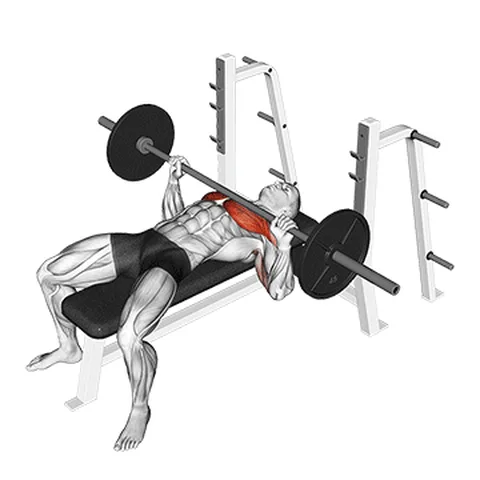
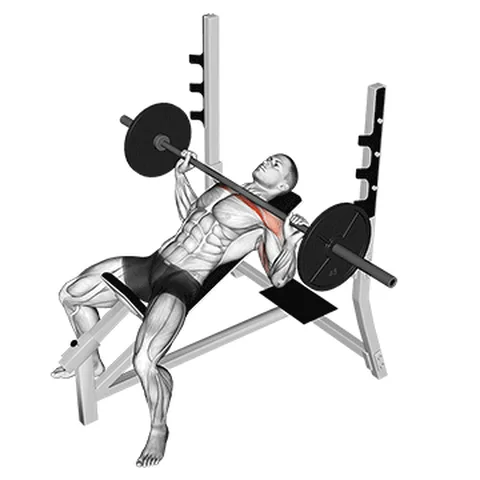
Barbell bench press
The same pattern lying down, with load you can increase in small steps. For building strength once push-ups get too easy.
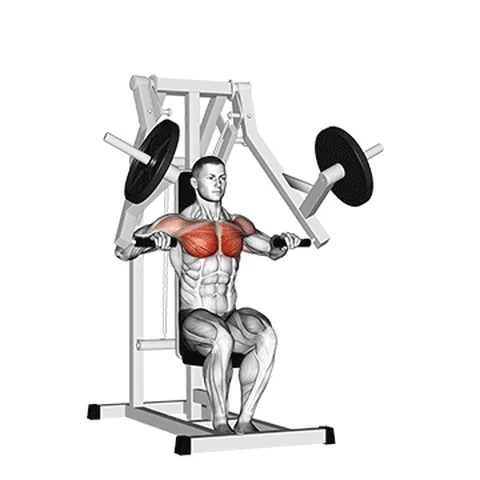
Machine chest press
Fixed path and adjustable weight: a gym alternative for going close to failure safely.
Sets and reps
| Goal | Sets | Reps | Rest |
|---|---|---|---|
| Muscle (hypertrophy) | 3-4 | 10-20 or near failure | 90 s |
| Endurance | 2-3 | Max with good form | 60-90 s |
| Beginners | 3 | 6-10 hands elevated | 90 s |
Progress by gradually lowering your hands until you are doing push-ups on the floor. Once you can do about 20 in a row, move to feet-elevated, a weight on your back, or a loaded press.
FAQ
How many push-ups should I do?
It depends on your level. What matters is that every rep is full; train in sets that take you close to failure and add reps week by week.
Do knee push-ups count?
Yes, but hands-elevated push-ups usually teach the full-body position better. Use whichever lets you do reps with good form.
Push-ups or bench press?
They train similar muscles. The bench lets you load exact weight and build strength; push-ups need no equipment and also train your core.
Alternatives
Related exercises
At a glance
- Primary
- Chest
- Equipment
- No equipment
- Steps
- 6

