
High bar squat
The high bar squat is the heaviest leg exercise you will do with a bar on your back. It mainly trains the quads and glutes, and your whole torso has to stay braced, so it works more than your legs.
Updated November 7, 2026
On this page
Why do it
In the high bar version the bar rests on your traps, your torso stays more upright and your knees travel further forward than in a low bar squat: more quads, a bit less hip. Do it first on leg day, while your technique and energy are fresh.
Setup
- Set the bar in the rack at mid-chest height, so you can unrack it without going onto your toes.
- Get under it and rest the bar on your traps, not on your neck. Grip it close to your shoulders and squeeze your upper back.
- Walk it out in two or three short steps and set your feet shoulder-width apart, toes turned slightly out.
How to do it
- 1
Stand with your feet shoulder-width apart, toes slightly turned out.
- 2
Hold the barbell across your upper back, resting it on your traps or rear delts.
- 3
Engage your core and keep your chest up as you begin to lower your body down.
- 4
Bend at the knees and hips, pushing your hips back and down as if sitting into a chair.
- 5
Lower yourself until your thighs are parallel to the ground or slightly below.
- 6
Keep your knees in line with your toes and your weight in your heels.
- 7
Drive through your heels to stand back up, extending your hips and knees.
- 8
Repeat for the desired number of repetitions.
Technique cues
- Take a breath, brace your abs as if you were about to be punched, and hold that pressure on the way down.
- Bend your hips and knees together, sitting down between your heels rather than behind them.
- Let your knees follow your toes; it is normal for them to travel past your toes.
- Stand up by pushing the floor away with your whole foot, keeping your heels down.
Muscles worked
Your quads do most of the work, especially out of the bottom. Your glutes and adductors help extend the hips, and your hamstrings stabilize the knee. Your lower back and abs do not move the bar, but they hold your torso in place: if they give out, you tip forward and the load shifts to your back.
- Primary
- Quadriceps
- Secondary
- Glutes, Hamstrings, Adductors
- Equipment
- Barbell, Squat rack
Common mistakes
1. Knees caving in
If your knees collapse inward as you stand up, actively push them out in the direction of your toes. If it keeps happening, lower the weight until you control it.
2. Heels coming up
With your weight on your toes you lose balance and overload your knees. Keep your weight across the whole foot; if your ankle mobility is limited, heeled lifting shoes help.
3. Not going deep enough
Half reps let you load more but train your glutes and quads less. Go at least until your thighs are parallel to the floor, as long as you can keep your position.
4. Hips rising before your chest
If your hips shoot up first out of the bottom, the squat turns into a good morning. Think about driving your chest and hips up together.
Variations and alternatives
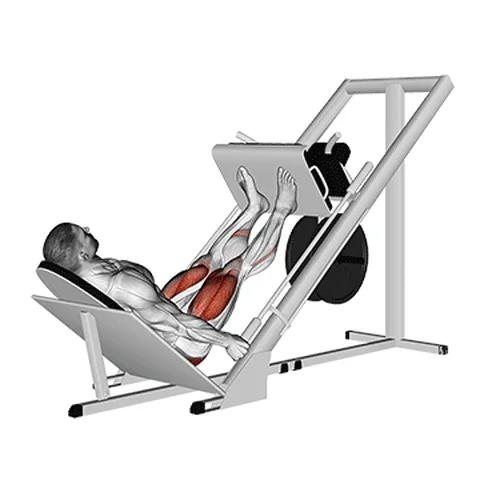
45-degree leg press
It trains the same muscles without loading your back or requiring balance. Good for extra volume after squats or for training close to failure.
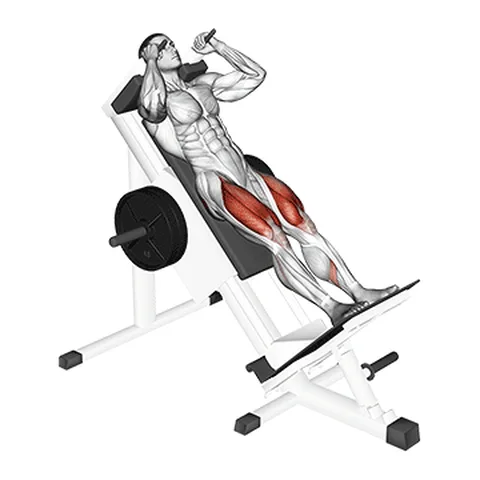
Hack squat
The machine guides the movement and supports your back, so your quads take almost all of the work.
Front squat
With the bar on the front of your shoulders, your torso stays even more upright and your quads work harder. It needs good wrist and upper-back mobility.
Sets and reps
| Goal | Sets | Reps | Rest |
|---|---|---|---|
| Strength | 3-5 | 3-6 | 3-5 min |
| Muscle (hypertrophy) | 3-4 | 6-10 | 2-3 min |
| Beginners | 3 | 8-10 | 2-3 min |
Learn the movement with the empty bar and add 5-10 lb once you complete every set with good form. One or two sessions a week are enough to progress; squats are fatiguing, so leave at least a day between them.
FAQ
High bar or low bar?
Both are good. High bar keeps your torso more upright and trains your quads more; low bar lets you lift a bit more and loads your hips more. If your goal is overall leg size, high bar is a good place to start.
How deep should I squat?
At least until your thighs are parallel to the floor. Deeper is fine too, as long as your lower back does not round at the bottom.
Do I need a belt?
Not to start. Learn to brace your abs first; a belt helps on heavy sets once your technique is solid.
Alternatives
Related exercises
At a glance
- Primary
- Quadriceps
- Secondary
- Glutes, Hamstrings, Adductors
- Equipment
- Barbell, Squat rack
- Steps
- 8

