
Seated shoulder press (dumbbell)
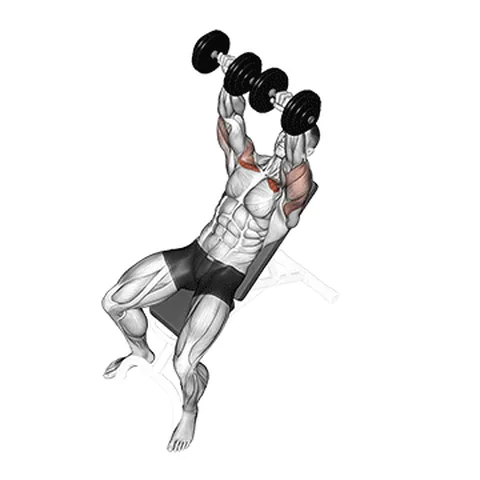
The seated dumbbell shoulder press mainly trains your front and side delts, with your triceps finishing each rep. Seated with back support, your torso barely has to stabilize, so the effort stays on your shoulders.
Updated November 7, 2026
On this page
Why do it
Because each arm works on its own, it helps even out one side with the other. Put it at the start of shoulder day, or after your chest press on push day, before lateral raises.
Setup
- Set the backrest almost upright, around 75-90°. Lower than that and it turns into an incline press.
- Rest the dumbbells on your thighs and kick them up one at a time with your knee until they are at shoulder height.
- Back and head on the pad, feet planted, with a natural slight curve in your lower back and no exaggerated arch.
How to do it
- 1
Sit on a bench with a dumbbell in each hand, resting on your thighs.
- 2
Raise the dumbbells to shoulder height, palms facing forward.
- 3
Press the dumbbells upward until your arms are fully extended overhead.
- 4
Pause for a moment at the top, then slowly lower the dumbbells back to shoulder height.
- 5
Repeat for the desired number of repetitions.
Technique cues
- Elbows slightly in front of your body, not flared straight out to the sides.
- Forearms vertical the whole way: the dumbbell always stacked over your elbow.
- Press until your arms are nearly straight, bringing the dumbbells close at the top without clanking them.
- Lower until the dumbbells are around ear or chin height, under control.
Muscles worked
The front delts work through the whole range and the side delts help mostly in the bottom half. The triceps take over near the top as your elbows straighten. If you stall just before lockout, your triceps are usually the limit; if you fail coming out of the bottom, it is your shoulders.
- Primary
- Shoulders
- Secondary
- Triceps
- Equipment
- Dumbbells
Common mistakes
1. Arching your back hard
Peeling your back off the pad turns the lift into an incline press and loads your lower back. Drop the weight and keep your back on the pad.
2. Half reps
Lowering only a few inches cuts the work your shoulders do. Go down to ear height even if it means using lighter dumbbells.
3. Elbows behind your body
With your elbows flared wide and back, your shoulders are in an awkward position and you lose strength. Bring them slightly forward.
4. Banging the dumbbells together
The clank takes tension off at the top and throws off the next rep. Bring them close without touching.
Variations and alternatives
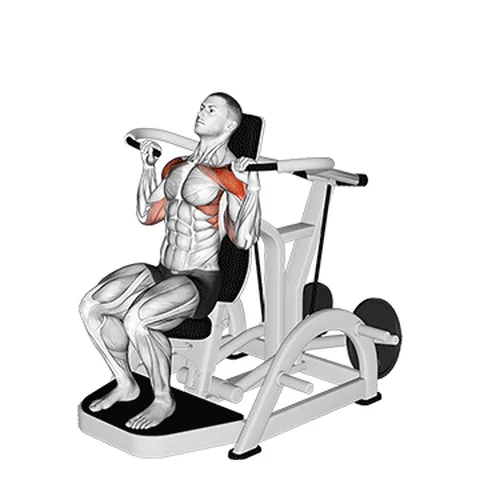
Machine shoulder press
The machine fixes the path, so you can go closer to failure without worrying about balancing dumbbells.
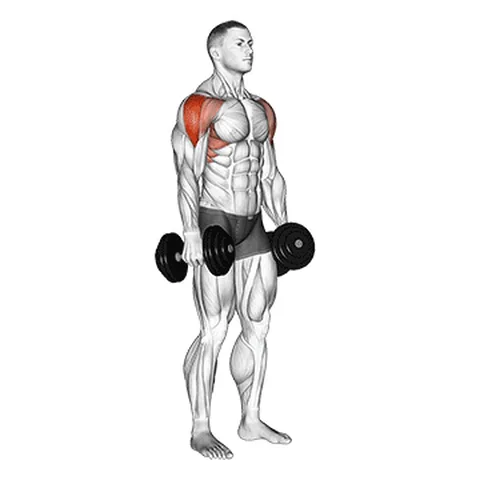
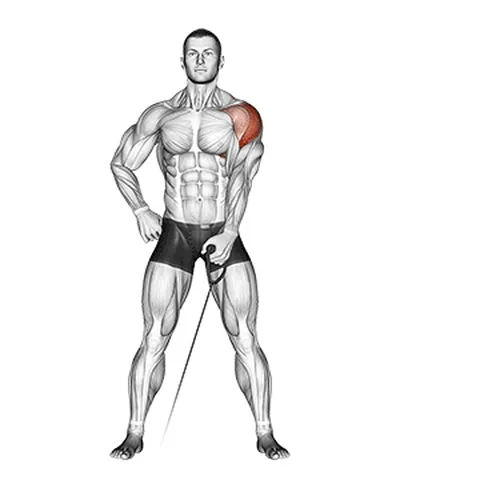
Dumbbell lateral raise
Isolates the side delts with no triceps. A good follow-up after pressing.
Standing barbell overhead press
Standing with a barbell, your torso and legs have to stabilize. More technical; you move more total weight.
Sets and reps
| Goal | Sets | Reps | Rest |
|---|---|---|---|
| Strength | 3-4 | 5-8 | 2-3 min |
| Muscle (hypertrophy) | 3-4 | 8-12 | 2 min |
| Beginners | 3 | 10-12 | 90 s-2 min |
Move to the next dumbbell (usually 5 lb heavier per hand) once you hit the top of the rep range on every set. That is a big jump relative to the weight: if it is too much, stay put and add reps first.
FAQ
How low should the dumbbells go?
To about ear or chin height, with your elbows a little below your shoulders. If that is uncomfortable, stop a bit higher.
Seated or standing?
Seated isolates your shoulders more and lets you load a bit more; standing also trains your core. Both work.
Dumbbells or barbell?
Dumbbells train each arm on its own and let you adjust the path to your shoulders; a barbell lets you lift more and progress in smaller steps.
Alternatives
Related exercises
At a glance
- Primary
- Shoulders
- Secondary
- Triceps
- Equipment
- Dumbbells
- Steps
- 5

